Does My Car Need ADAS Recalibration After a Collision in Victoria?
John's Auto Body & Paint has been repairing vehicles in Victoria for more than 35 years, and we handle both ICBC and private insurance claims on every job that comes through our shop on Dupplin Rd. One thing we're seeing more of lately, and one most drivers have never heard of, is ADAS calibration.
What Is ADAS Calibration, Exactly?
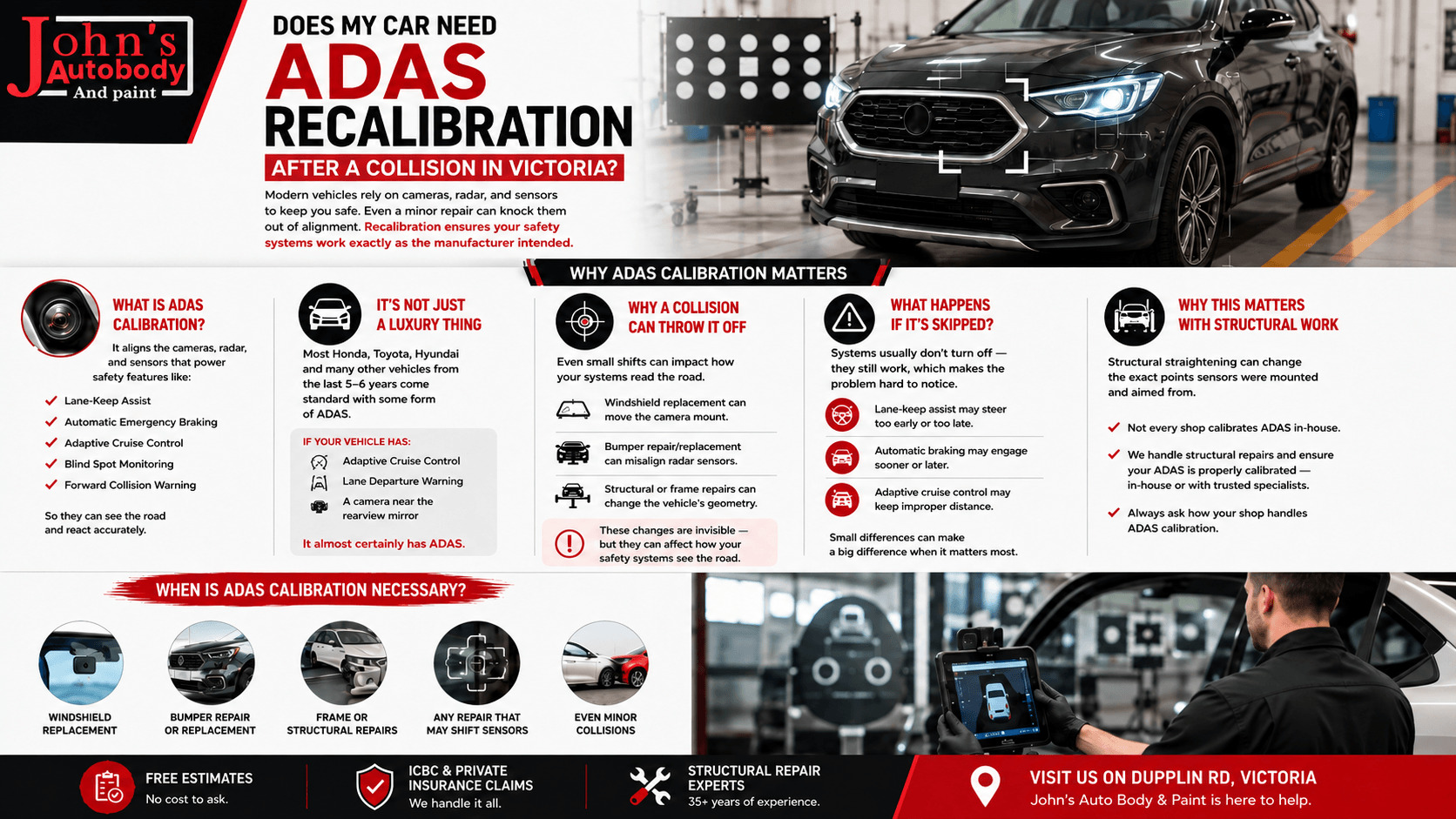
ADAS stands for advanced driver assistance systems — the general term for the cameras, radar, and sensors that enable features like lane-keep assist, automatic emergency braking, and adaptive cruise control.
Calibration is the process of resetting those cameras and sensors so they know exactly where they're pointed and how to read the road correctly, because even a small shift in position can throw the whole system off.
Think of it like glasses that have slipped half a centimetre down your nose. You can still see fine, but nothing quite lines up the way it should. That's what an uncalibrated ADAS system is doing every time it makes a decision for you.
It's Not Just a Luxury-Car Thing
A lot of Victoria drivers assume ADAS is something reserved for German luxury cars, and that hasn't been true for a while. Most Honda, Toyota, and Hyundai models built in the last several years come with some form of driver assistance as standard equipment, not an upgrade you had to pay extra for.
If your car has adaptive cruise control, a lane departure warning, or a small camera housing near the rearview mirror, it almost certainly has ADAS. The safest assumption for anyone driving something built in the last five or six years is that it does — and it's worth confirming rather than guessing.
Why a Collision Repair Can Throw It Off
This is the part most drivers don't think about. ADAS relies on cameras and sensors sitting in very specific spots, usually behind the windshield, inside the front bumper, or built into the grille. A collision doesn't have to be severe to move one of those components.
- Replacing a windshield can shift the camera mounted to it by a fraction of a millimetre — enough to change what the system thinks it's looking at.
- A bumper repair or replacement can do the same thing to a radar sensor hidden behind the plastic.
- If the frame or structure of the vehicle needed straightening, the entire geometry of the car has changed relative to where those sensors were originally aimed.
None of this shows up as visible damage afterward. The car looks fine and drives fine. The sensors, though, may now be reading the road from a slightly different angle than the manufacturer intended.
What Happens If It's Skipped
Skipping calibration usually doesn't mean the systems turn off. In most situations they'll still work, which is exactly why the problem can be hard to notice.
Lane-keep assist might nudge the steering wheel a little earlier or later than it used to. Automatic braking might engage at a slightly different point than it did before the repair. Adaptive cruise control might hold a following distance that's longer or shorter than you're used to.
None of these things is certain, and every car behaves a little differently. Still, these are the kinds of differences that matter when a safety system is making split-second decisions for you.
Why This Matters If Your Car Needs Structural Work
Structural straightening is one of the more involved parts of collision repair, and it's also one of the repairs most likely to affect a vehicle's sensors, since it can shift the exact points those sensors were originally mounted and aimed from.
Not every shop offers ADAS calibration services in-house. Some handle it directly and some route it to a specialist, so it's worth asking whoever does the repair how they handle it.
Structural straightening is something we do as part of our collision repair work here, and if you're getting a free estimate with us, it's a fair question to bring up so you know where your vehicle stands before any work begins.
Frequently Asked Questions
What is ADAS calibration?
ADAS calibration is the process of aligning and resetting the cameras and sensors on your car. This step ensures that driver assistance features, like lane-keep assist or automatic braking, can read the road properly. You'll usually need ADAS calibration after someone repairs your windshield, bumper, or vehicle structure.
How long does ADAS calibration take?
The car and the systems that need attention will determine this. Some calibrations can be done with the car parked in the shop, while others require a short road test to finish properly. Ask us for a time estimate once we've had a look at your specific vehicle.
How much does ADAS calibration cost?
ADAS calibration cost varies by make, model, and the number of systems involved. It's best to work it out as part of your full repair estimate rather than guessing ahead of time, so ask us for specifics once we know what your car actually needs.
When is ADAS calibration necessary?
Generally, any time a windshield is replaced, a bumper is repaired or replaced, or the frame or structure is worked on. Even minor repairs can shift a sensor enough to require recalibration, so it's worth asking whenever a repair touches one of these areas.
Who does ADAS calibration?
It should be handled by a shop that understands where your vehicle's sensors sit and how a particular repair might affect them. We assess this as part of the collision repair process and can walk you through what your specific car needs before work starts.
If You're Not Sure, Bring It In Before You Drive Off
If your car has recently had a windshield, bumper, or frame repair, it's worth confirming whether calibration was included — especially if you're not sure your last shop covered it.
If you've been searching for ADAS calibration near me, that's a fair question to raise wherever you get your next collision or structural repair done, including here at John's Auto Body & Paint on Dupplin Rd. We handle the structural side of the repair and offer free estimates, so there's no cost to ask.