Will Your Car Be Worth Less After an Accident, Even After a Perfect Repair?
John's Auto Body & Paint has repaired vehicles in Victoria for more than 35 years and handles both ICBC and private insurance claims, from the first estimate through to the final inspection. One question we hear often, usually after the repair is already done, is whether the accident itself will cost the car owner money down the road. It's a fair thing to wonder about, so here's what a diminished value claim actually involves.
What Diminished Value Actually Means
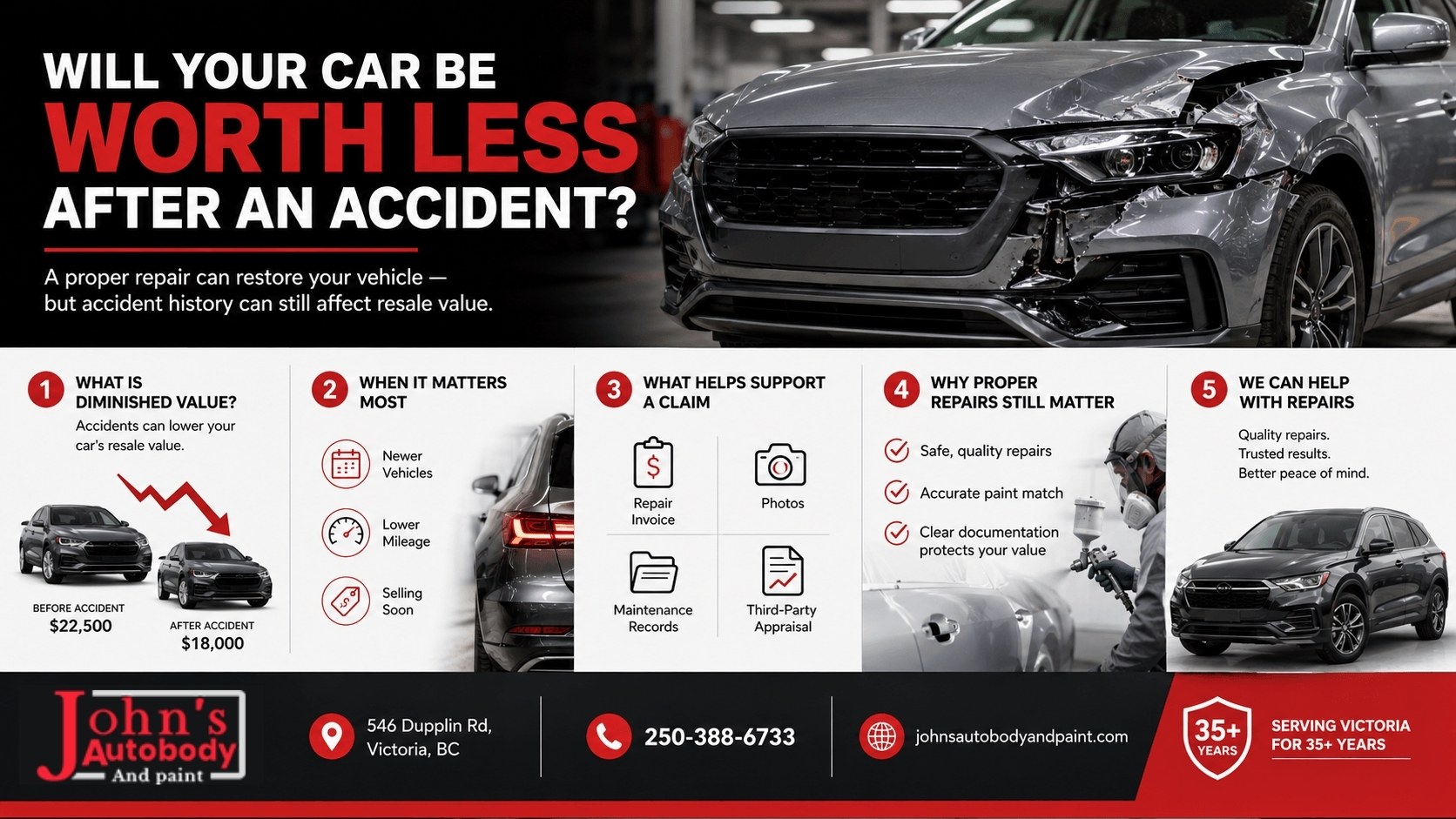
A diminished value claim is about the difference between what your car was worth the day before the accident and what it's worth once the repair is finished — when that repair is done properly. The collision becomes part of the vehicle's history the moment it's reported, and that history often follows the car through a vehicle report or a dealer's appraisal.
So the panels can line up perfectly. The paint can match exactly. And the car can still carry a lower resale or trade-in value than an identical vehicle with a clean record. That gap is what people mean by diminished value.
How This Is Generally Treated in BC
There isn't a single rule that covers every situation, and how a diminished value claim in BC is handled depends largely on the details of your accident and who your insurer is.
If you weren't at fault, a diminished value claim is usually directed at the at-fault driver's insurance rather than your own policy, since it's treated as a separate loss from the repair cost itself.
ICBC handles a large share of claims in this province, and while its process focuses primarily on repair costs and, in the case of a total loss, the vehicle's cash value, a diminished value claim with ICBC beyond that is something an adjuster would need to assess on a case-by-case basis.
Private insurers work a little differently depending on the policy, and coverage for this kind of loss isn't automatic just because you have collision or comprehensive coverage.
None of this is something we can decide on your behalf. It's a conversation worth having directly with your adjuster or insurer, who can tell you what applies to your specific policy and claim.
When This Actually Matters
Diminished value matters most for newer, low-mileage vehicles, or cars the owner plans to sell or trade in within the next year or two. When comparing two similar cars, a buyer will often pay less for the one with a history of accidents. That gap tends to be more noticeable the newer or lower-mileage the vehicle is, since those are the cars where a clean history carries the most weight in a sale.
If your car is older, already has higher mileage, or you're planning to keep it for years rather than sell it, this is honestly less likely to affect you in any meaningful way — and it's fair to say so rather than suggest otherwise to make a point. A ten-year-old commuter car with a long history of normal wear isn't in the same position as a two-year-old vehicle that was still under its original loan.
It's still worth understanding the general idea behind a car accident diminished value claim, even if it turns out not to apply much to your own situation once you think it through.
What Supports a Claim Later
If you want to try for a diminished value claim, you need to have all your paperwork ready. Documentation is what makes an auto diminished value claim work.
- Keep a clear, itemised repair invoice showing exactly what was done.
- Take before-and-after photos of the vehicle.
- Save every record that shows the parts and the work used to restore the car to its pre-accident condition.
- Hold on to the photos taken at the estimate stage — they show the extent of the original damage rather than just the finished result.
An independent appraisal can also help establish the value gap later on, though that's a separate step from the repair itself and not something we provide.
None of this is legal advice, and we're not appraisers or adjusters, but a properly documented repair naturally leaves you with the paperwork trail that a claim like this tends to depend on. Keeping that file together, even loosely, puts you in a better position than trying to reconstruct it months after the fact.
Frequently Asked Questions
What is a diminished value claim?
It's a claim for the drop in a vehicle's resale or trade-in value resulting from an accident in its history, separate from the cost of the physical repair. Even a repair that looks and drives like new can leave a car worth less on paper than it was before the collision.
How do you negotiate a diminished value claim?
To file a claim with the appropriate insurance — often the at-fault party's insurer if you weren't at fault — you typically need to gather paperwork such as repair records, photos, and an independent evaluation. Since each case is unique, it's worthwhile to have a direct conversation with an adjuster or, if necessary, a specialist who handles these claims regularly.
Does diminished value apply if I wasn't at fault?
Not being at fault is generally the more common scenario where a diminished value claim gets raised, since the loss is typically directed at the at-fault driver's insurance rather than your own. That said, whether a specific claim is accepted, or how it's valued, is decided by the insurer involved — not by us.
Can I claim diminished value against my own insurance?
Coverage for diminished value under your own policy varies by insurer and by what you've actually signed up for, and isn't guaranteed just because you carry collision or comprehensive coverage. Some policies address it in some form, and others don't touch it at all. The best way to know for certain is to ask your own insurer directly what your specific policy covers before you assume either way.
The Repair Is the Part We Control
We can't tell you what any insurer will decide about a diminished value claim, and we'd rather be upfront about that than promise something we can't back up. What we can do is make sure the repair is done properly, and that you walk away with clear documentation of the work in case you ever need it.
That's exactly what John's Auto Body & Paint focuses on with every repair that comes through our shop on Dupplin Rd, whether it's an ICBC claim or a private one. If your car has recently been in an accident, or you're weighing whether to fix it before selling, bring it in and let us show you what a proper collision repair and a paper trail that actually holds up look like.