OEM vs. Aftermarket Parts: What Actually Gets Used to Fix a Car in Victoria (and Does Insurance Cover It)?
If you're partway through a claim and an estimate lands with the word "aftermarket" on it, that single term can raise more questions than it answers. Understanding OEM vs aftermarket parts makes the rest of the estimate a lot easier to read, so here's what the two categories actually mean and how the choice between them tends to get made.
What OEM and Aftermarket Actually Mean
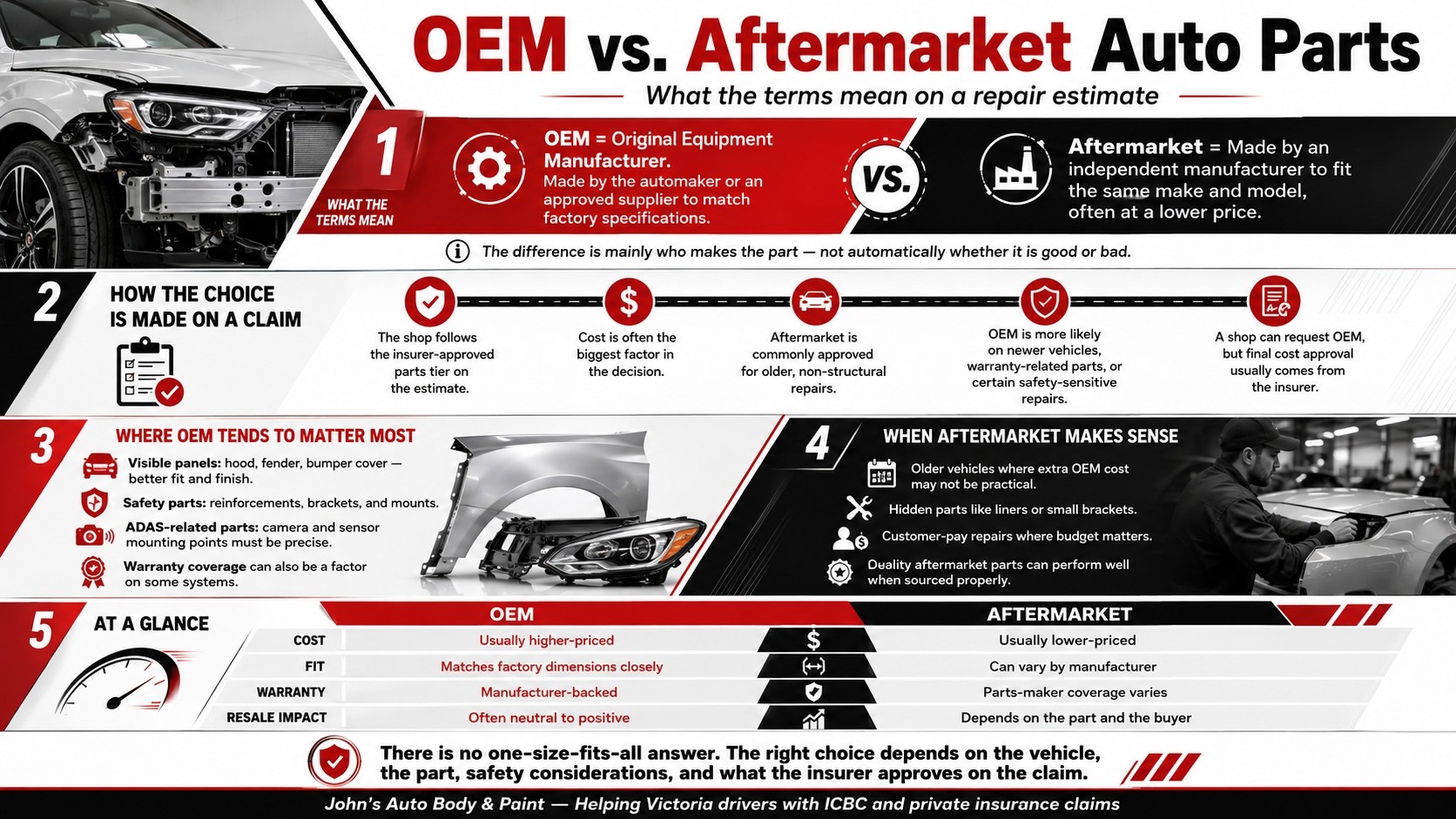
OEM stands for original equipment manufacturer. An OEM part is made by the same company that built your car, or by a supplier working directly under contract with that automaker, so it matches the factory specification down to the mounting points and the finish.
Aftermarket is the other category: parts made by an independent manufacturer to fit the same make and model, usually at a lower price.
In plain terms, the aftermarket auto parts meaning comes down to who makes the part, not automatically to how good it is. Both categories cover almost everything on a vehicle, from bumper covers and headlights to structural brackets underneath the body panels.
How the Choice Usually Gets Made on a Claim
A shop doesn't just grab whichever part happens to be closest on the shelf. On most insurance claims, an adjuster reviews the repair estimate and confirms which parts tier is approved before any work begins.
Cost is usually the biggest factor in that decision. Aftermarket parts are often cheaper to source, so insurers frequently default to them for non-structural repairs once a vehicle is a few years past its original build date. Newer vehicles, or repairs involving a part still under a manufacturer's warranty, are more likely to receive OEM approval by default.
This is where the question of aftermarket parts insurance coverage really comes in. Every insurer sets its own guidelines, and ICBC aftermarket parts practices aren't necessarily identical to those of a private insurer, though the basic reasoning is generally the same for both.
A shop can request OEM on a customer's behalf, but final cost approval generally rests with the insurer.
Where the Difference Actually Matters
On a highly visible panel like a hood, fender, or bumper cover, fit and finish is where OEM tends to earn its reputation. These parts are engineered to match panel gaps and mounting points precisely, making it easier for a technician to achieve a factory-level finish on the first attempt. An aftermarket version of the same panel may require more adjustment during installation and, in some cases, won't sit quite as cleanly no matter how much time goes into it.
Safety-critical components are the other area where the distinction carries real weight. Bumper reinforcement bars, crash-absorbing structures, and any bracket holding a camera or sensor for driver-assist features like lane-keep or automatic braking all need to be dimensionally correct to function as designed. A part that sits even slightly off can change how the safety system reads the road.
Warranty coverage is worth considering too, since fitting a non-OEM part to certain systems can change what the vehicle manufacturer will still cover later on.
Where Aftermarket Is a Reasonable Choice
None of this means aftermarket is automatically the wrong choice. On an older vehicle that isn't worth a great deal any more, it's hard to justify a significant premium for OEM on parts nobody will ever see — a fender liner, say, or a small bracket tucked behind a panel.
The same logic applies when you're paying out of pocket rather than through a claim.
Reputable aftermarket manufacturers build to recognised standards, and on many repairs their parts fit and look every bit as good as the OEM equivalent. The category on an estimate is a starting point for the conversation, not a verdict on quality.
OEM vs. Aftermarket Parts Comparison at a Glance
The table below is a simple reference point for the OEM vs aftermarket parts comparison drivers usually want when they're mid-claim and trying to understand what a term on their estimate actually means. It isn't a ranking of one over the other, just a snapshot of where the two categories tend to differ, since much of the confusion around this topic comes from assuming one is always the safer or smarter pick.
| OEM | Aftermarket | |
|---|---|---|
| Cost | Generally the higher-priced option, sourced through the manufacturer | Usually the lower-cost option, sourced from an independent maker |
| Fit | Matches factory dimensions and mounting points exactly | Varies by manufacturer, may need extra adjustment during install |
| Warranty | Backed by the vehicle manufacturer's own terms | Backed by the parts maker, and coverage varies by brand |
| Resale impact | Generally viewed as neutral to positive on a vehicle history | Can occasionally be noted on an inspection or history report, with effect on resale varying by buyer and part |
None of these categories is a fixed rule an insurer has to follow. They're general tendencies, and the actual outcome on any one claim depends on the vehicle, the part, and the policy behind it.
Frequently Asked Questions
What's the difference between OEM and aftermarket parts?
OEM parts are manufactured by, or on behalf of, the vehicle's original manufacturer and built to that exact factory specification. An independent company produces aftermarket parts for the same vehicle, and quality can range from nearly identical to OEM to noticeably rougher depending on the brand. The category alone doesn't tell you whether one specific part is good — it just tells you who made it.
Does ICBC or private insurance cover OEM parts in Canada?
It depends on the vehicle, the part in question, and the insurer's guidelines, so there isn't a single answer that applies to every claim. Generally, insurers are more inclined to approve OEM parts for newer vehicles or parts still under a manufacturer's warranty, and more likely to default to aftermarket for older vehicles or non-structural repairs. Whoever is handling a specific claim is the one who confirms what's actually been approved.
Will aftermarket parts affect a car's resale value?
It can, depending on which part was used and how the repair shows up on a vehicle history report. A well-installed, quality aftermarket panel usually isn't a concern to most buyers. A report flagging aftermarket parts on a safety-critical component, though, can make a cautious buyer hesitate during a private sale or a dealer trade-in appraisal. The effect tends to be more noticeable on newer or higher-value vehicles than on older ones.
Can a customer request OEM parts for their repair?
Yes, a customer can generally request OEM parts on their own claim. Whether that request gets approved, and whether the customer ends up covering any difference in cost, comes down to the specific insurance policy and what the claim's adjuster is willing to sign off on.
The Bottom Line
There isn't a single right answer between OEM and aftermarket. It comes down to the vehicle's age, which part needs replacing, whether a safety system is tied to it, and what the insurer approves for that particular claim.
Drivers working through a claim in Victoria are generally best served by asking their adjuster directly what's been approved and why, since the answer shifts case by case. John's Auto Body & Paint handles both ICBC and private insurance claims.